Plexus Spectral Dynamics

Make room where your sounds collide.

A true-peak limiter and complete stem processor for stereo, surround, immersive and Ambisonic audio. Control peaks, level and filter speaker channels, manage the low end—and when another signal needs priority, make room with 32-band spectral ducking.

See use cases
True-peak limiting across a 7.1.4 stem, with independent channel processing and optional 32-band ducking from a mono sidechain key.

A multichannel stem is not one signal

Every channel can need a different level, filter and limiter response.

Treating the complete stem as one block can shift the image, leave individual peaks exposed or force you to build a chain of processors for jobs that belong in the same signal flow.
The Plexus response

Limit the stem. Shape every channel. Make room when you need it.

Plexus combines a true-peak limiter, per-channel level and filtering, bass management and sidechain-driven spectral ducking. Use one function on its own or keep the complete chain on the stem.

Concrete mix situations

Make the busy stem move for the signal that matters.

Insert Plexus on the stem that should give way, then feed the priority signal to its sidechain. The key can be dialogue, music or effects; you decide which bands and speaker channels respond.

MUSIC MAKES ROOM FOR DIALOGUE

Keep the voice clear without emptying the score

Insert Plexus on the music stem and feed dialogue to the sidechain. Clear the front stage more firmly, touch surrounds and heights more gently and leave everything outside the competing bands present.

MUSIC MAKES ROOM FOR EFFECTS

Let the important effect cut through the music

Insert Plexus on the music stem and key it from the effect that must lead—a hit, pass-by, transition or other foreground moment. Faster timing can open a precise spectral pocket without pulling the entire score down.

EFFECTS MAKE ROOM FOR DIALOGUE

Find speech inside a wall of sound

Insert Plexus on the effects stem and feed dialogue to the sidechain. Target the centre, fronts or any selected speakers so engines, crowds, weather and impacts yield only where intelligibility needs space.

AMBISONIC LIMITING

Protect B-format without distorting the soundfield

Use Plexus as a true-peak limiter on first-, second- or third-order ACN/SN3D buses. LINK is forced to ALL and every component follows ACN 0, preserving the encoded field under gain reduction.

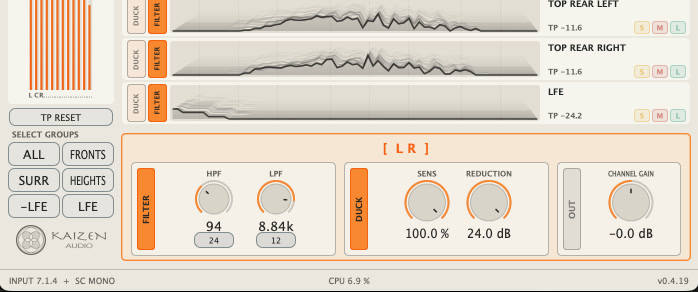
Plexus channel selection groups with per-channel filter and duck switches plus controls for the selected L and R channels
Select a channel, a hand-picked pair or a speaker group, then set gain, filters and—when needed—spectral reduction for that selection.

A true-peak limiter at the centre

Protect the complete stem without giving up channel control.

True-peak limiting

A final true-peak protection stage for the complete stem, with a shared ceiling and clear peak and gain-reduction history for every channel.

Three limiter relationships

Use UNLINK for maximum channel independence, PAIRS to hold recognised left/right images together or ALL to preserve the balance of the non-LFE field. Ambisonic buses lock safely to ALL.

Per-channel level

In speaker layouts, every channel has its own gain stage before the limiter. Work on one channel, a hand-picked pair or a complete speaker group without splitting the stem.

Per-channel filters

Independent high-pass and low-pass filters define the useful range of every speaker channel, with linked edits for the current selection.

32-band spectral ducking

When another signal needs priority, the sidechain key drives frequency-dependent reduction only in the bands and channels that need to move.

Integrated bass management

A Linkwitz–Riley fourth-order crossover redirects low-frequency content from the main speakers to LFE, integrated with the channel filter edges.

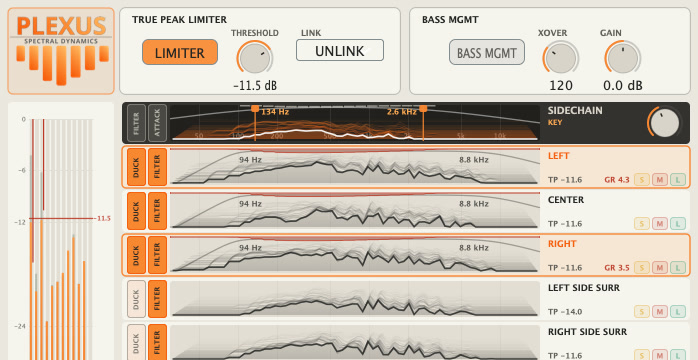
Plexus true-peak limiter, bass management, sidechain range, per-channel filter and duck switches, and active multichannel spectra
Limiter state, per-channel true peaks, filters, gain, bass management and optional sidechain activity remain visible in one window.

The final dynamics stage

Start with true-peak protection. Bring in the other stages only when they solve something.

The signal moves through channel filters, bass management, optional spectral ducking and independent channel gain before reaching the final true-peak limiter. Plexus can do any one of those jobs on its own—or keep the entire stem under control in one coherent signal path.

When two signals collide, feed the priority signal to the sidechain. Plexus analyses that key in 32 bands and applies frequency-dependent reduction only to the channels, selected pairs or speaker groups that should give way.

See the complete signal flow →

Speaker and Ambisonic formats

  • ○ Mono, stereo and speaker layouts through 9.1.6
  • ○ First-, second- and third-order Ambisonics
  • ○ ACN channel order with SN3D normalisation
  • ○ Ambisonic limiter locked to ALL for field coherence
  • ○ All Ambisonic components follow ACN 0

Bass management is disabled in Ambisonic mode because an encoded B-format bus has no LFE speaker channel.

Frequently asked questions

Is there a free trial?+

Yes — a free 15-day trial with the complete plug-in unlocked. No credit card is required.

How do licences work?+

Your licence includes 2 seats, so you can run Plexus on two machines at once. Move a seat to another computer whenever you need, and activate offline if your room has no internet. No iLok is required.

Which plug-in formats and systems are supported?+

AAX Native, VST3 and Audio Units (AUv2) on macOS 12 or later, Universal for Apple Silicon and Intel. Plexus runs from 44.1 to 192 kHz in a host with a supported multichannel bus; there is no standalone app or AAX DSP version.

Does Plexus always need a sidechain?+

No. Only the 32-band spectral ducker needs a key signal. True-peak limiting, channel gain and filters, and bass management all work without a sidechain.

Where is bass management available?+

On speaker layouts that include front Left, front Right and LFE. It has no route to build on mono or stereo buses and is disabled in Ambisonic mode, where the channels are encoded components rather than speaker feeds.

Why is there latency when the limiter is off?+

Plexus reports a fixed latency at each sample rate—159 samples at 48 kHz—and keeps it unchanged when the limiter is switched off. That lets the DAW maintain stable delay compensation through automation and bypass changes.

Can the built-in true-peak readings be used for delivery sign-off?+

Use them to operate Plexus and inspect each channel while setting the limiter. For formal broadcast, cinema or streaming compliance, use the dedicated meter required by the delivery specification.

Perpetual licence

Finish the stem with true-peak control.

Use Plexus as your everyday true-peak limiter, then add per-channel shaping, bass management or spectral ducking without adding another insert.

€99 One-time

Includes 2 licence seats—move them between machines, online or offline. No iLok.

Try the complete plug-in free for 15 days. No credit card required.

True-peak limiting with UNLINK, PAIRS and ALL modes
Independent gain and filters for every channel
Integrated bass management
Optional 32-band spectral ducking
Ambisonic limiting through third order